
The problems identified hold lessons for the rest of Canada
(Toronto, ON) – Ontario’s care policies get a failing grade for being weak, outdated, and not going far enough to meet the care needs of provincial residents, finds a new report on the province’s care economy released today by Ontario Nonprofit Network (ONN).
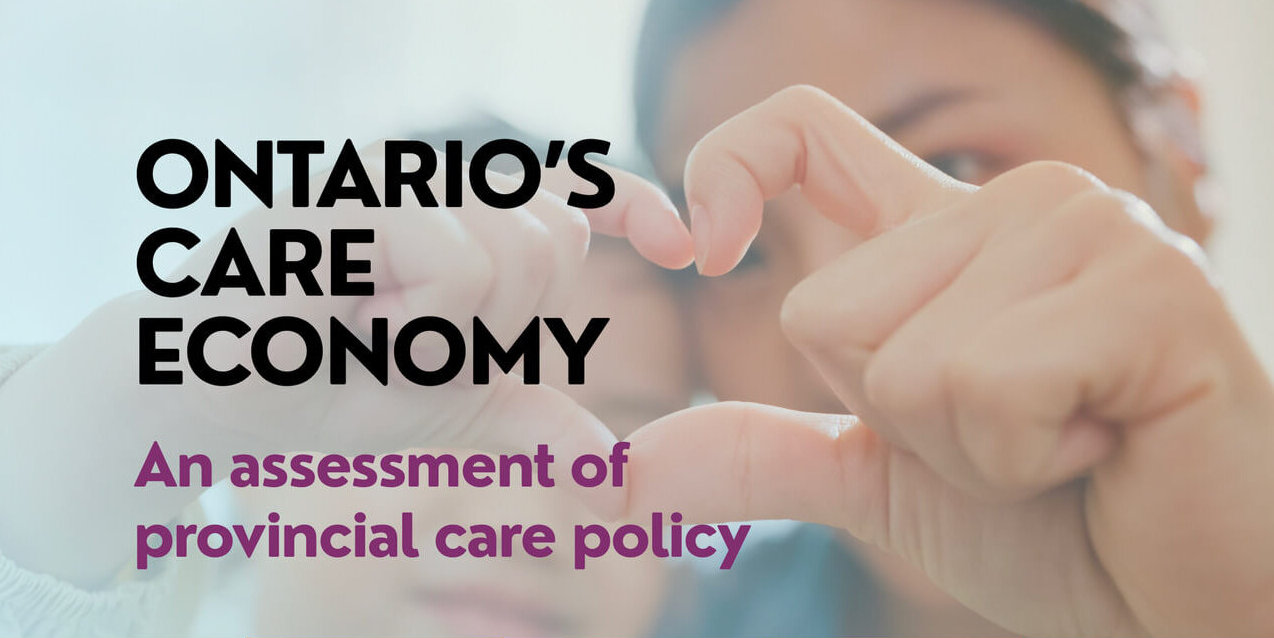
The report, Ontario’s Care Economy: An assessment of provincial care policy, identifies significant gaps in provincial policies underpinning the care economy – including employment standards laws that do not reflect the expansion of care work into the gig economy, unaffordable and precarious housing, inadequate infrastructure funding, and the growing privatization of care services.
These shortfalls are forcing care systems to operate at unsustainable levels, with impacts evident in Ontarians struggling to access childcare, seniors care, affordable housing, and many other services.
While the report is specific to Ontario, its findings hold lessons for the rest of Canada.
The “care economy” includes all of the labour – both paid and unpaid – that goes into meeting the physical, psychological, and emotional needs of individuals, families, and their communities. It is delivered through the public, private, and nonprofit sectors and within households.
While the care economy relies on unpaid family caregivers and paid care workers – who are mostly women and predominantly Black, racialized, immigrant and migrant women – public policy often neglects or undervalues them.
“The care economy impacts everyone. Without it, Canada’s other economic sectors could not function,” said Pamela Uppal-Sandhu, Director of Policy at ONN.
“Yet, as this report lays bare, Ontario’s care economy is in a precarious state. It is underfunded, under-resourced and unable to keep pace with care needs, putting pressure on unpaid caregivers to fill gaps and pushing care workers to the brink,” Uppal-Sandhu said.
Decades of government austerity measures – including privatization, deregulation, funding cuts, and downloading services to municipalities – have put increasing pressure on nonprofit organizations to provide care for a rapidly growing and increasingly complex client base while coping with stagnant budgets.
Front-line care workers bear the brunt of gaps in care while earning barely livable wages themselves and often carrying the burden of unpaid care duties at home.
The report, based on research and consultations by Vivic Research, used a scorecard to rate Ontario’s care policies. It found that:
- Investments in the care sector are not keeping pace with rising care needs.
Provincial policies are failing to address housing precarity and the high cost of living, with proposed housing reforms threatening to further erode tenant protections and drive up homelessness.
- Deregulation, privatization, and lack of funding and maintenance for care-enabling infrastructure – including access to clean and safe drinking water, internet connectivity, and public transit – are increasing the burden on care workers.
- The growing privatization of care services – including in addiction treatment, mental health, long-term care, and surgical services – has created a two-tiered care system that undermines access and the delivery of nonprofit services.
- Punishment and criminalization have replaced services and support for those most in need, increasing their risk of incarceration, institutionalization, or death.
- Weak employment legislation is leaving care workers vulnerable to poor working conditions, workplace abuse, and exploitation.
Despite sector experts, advocates, frontline workers, and labour unions sounding the alarm for years, Ontario’s care economy continues to be overburdened and underfunded.
To turn it around, the report calls for a refocus that puts care and the care economy at the centre of policy decisions in order to build a “careFULL Ontario.” This includes:
- Moving away from criminalization and towards public policy that centres care by investing in care systems and services and repealing legislation that makes behaviours and survival strategies that stem from unmet care needs illegal.
- Recognizing care-enabling physical infrastructure as an essential component of care by involving care advocates in policy decisions, investing in rent-geared-to-income housing, and tenant protections and implementing free transit services for care workers and others in need.
- Ensuring decent working conditions for care workers, including paying competitive wages, modernizing and beefing up employment standards, and prioritizing preventive workplace safety measures.
- Bolstering the care economy by investing in public and nonprofit care systems, from primary care and home care to safe consumption sites and mental healthcare, to reduce reliance on emergency services and ensure care is accessible to all.
- Taking profit out of care by ending privatization, prohibiting deregulation, redirecting public money into public-sector services, and moving toward long-term core funding models.
- Creating better conditions for unpaid care, including implementing a basic income.
“Building up the care economy will produce significant benefits,” said Uppal-Sandhu.
“A healthy care economy is not only good for people – especially women – but it also produces positive results for the economy, the environment and government revenues as it pays large dividends in improving the well-being of Ontarians.”
The full report is available at https://theonn.ca/publication/ontario-care-economy-report/.
-30-
About Ontario Nonprofit Network (ONN)
ONN is the independent network for the 58,000 nonprofits in Ontario, focused on policy, advocacy, and services to strengthen Ontario’s nonprofit sector as a key pillar of our society and economy. We work to create a public policy environment that allows nonprofits to thrive. We engage our network of diverse nonprofit organizations across Ontario to work together on issues affecting the sector and channel the voices of our network to governments, funders and others in the nonprofit ecosystem.
Media Contact:
Kathleen O’Grady, QUOI Media Group Inc.
kathleen54@rogers.com
613-897-9276