

Canada’s hidden economic and innovation engine deserves recognition
Canada’s charities and nonprofits employ 2.9 million people, contribute 8.4 per cent of the GDP annually – more than mining, oil and gas, agriculture, transportation or retail. Yet ask most people in Canada to name the engines of our economy and leaders of innovation, and this sector would barely make the list.
It should top it
Every single person in Canada relies on this sector and its critical services, from coast to coast, usually without noticing. The hospital where your mother is recovering. The university training tomorrow’s doctors and engineers. The food bank feeding families at month’s end. The cancer research behind the next breakthrough treatment. The settlement agency that helps a newcomer family become citizens.
Canada’s 170,000 charities and nonprofits include universities and research institutes, innovation hubs and theatres, conservation trusts and shelters, sports leagues and places of worship. Together they generate $244 billion in economic activity. Yet they are chronically underfunded, scrambling for adequate resources from budget cycle-to-cycle.
When austerity budgets happen, they are often the first to be cut.
We come to this from the Senate, the House of Commons, philanthropy and the sector itself. We agree on one thing: Canada cannot build a stronger middle class without a stronger and sustainable nonprofit sector.
Consider the jobs: nurses, early childhood educators, researchers, counsellors. The sector is where many young people and newcomers get their start. It is highly skilled: 48 per cent have a university education, compared with 34 per cent of all workers. Yet they earn 13 per cent less on average. Too often, these are becoming jobs people cannot afford to keep.
Consider, too, the services: childcare, elder care, after-school programs, arts and culture, sports, mental-health supports. This is the infrastructure that lets working families work, and governments increasingly rely on nonprofits to deliver it. The National Advisory Council on Poverty warns the sector is stretched beyond its limits, even as rising costs push more families to its door.
Many nonprofit staff rely on food banks to manage their grocery bills.
This sector does not simply absorb shocks. It innovates.
Canada’s global leadership in artificial intelligence is, in large part, a nonprofit story. Geoffrey Hinton’s Nobel-winning work on neural networks was supported for years by The Canadian Institute for Advanced Research, a Canadian charity. CIFAR went on to lead the Pan-Canadian AI Strategy, whose three national AI institutes, Amii, Mila and Vector, are all nonprofits.
That spirit runs across the sector today. Second Harvest uses technology to rescue surplus food and get it to communities in need. Actua is teaching young people to code and build with AI. The Nature Conservancy of Canada is protecting land and water at national scale.
Social innovation follows the same pattern. Housing First, now central to federal homelessness policy, was proven in Canada through At Home/Chez Soi, a large-scale trial led by the Mental Health Commission of Canada. The sector tests the ideas. Governments scale them.
So why is this sector overlooked when important economic decisions are made? Banks, manufacturers and tech giants fill those tables. Nonprofits are asked to deliver the programs, not shape the strategy. The organizations doing this work in our communities go unseen.
And too few young people see a nonprofit career as a first choice rather than a sacrifice. That is a failure of policy, not of the sector.
A practical first step is before Parliament by MP Eric St-Pierre, in a sponsored petition e-7307, which calls for the third Thursday of February to be recognized as a National Day of Appreciation for the Nonprofit Sector.
The idea is neither new nor partisan. NDP MP Don Davies put forward Motion M-131. Ontario’s Progressive Conservative government legislated a Nonprofit Sector Appreciation Week and British Columbia, New Brunswick, Nova Scotia and PEI hold days of recognition.
The U.S. and UK officially recognize the value of the sector.
A national day would cost little. But we are not asking for a thank-you card. We are asking Canada to treat this sector as a pillar of the economy: count it properly in economic data, give it a seat where decisions are made and fund it sustainably so organizations can plan beyond the next grant cycle.
Visibility shapes understanding and understanding shapes policy.
The government should answer this petition with a clear yes. Canada already runs on nonprofits. It is time to recognize that fact.
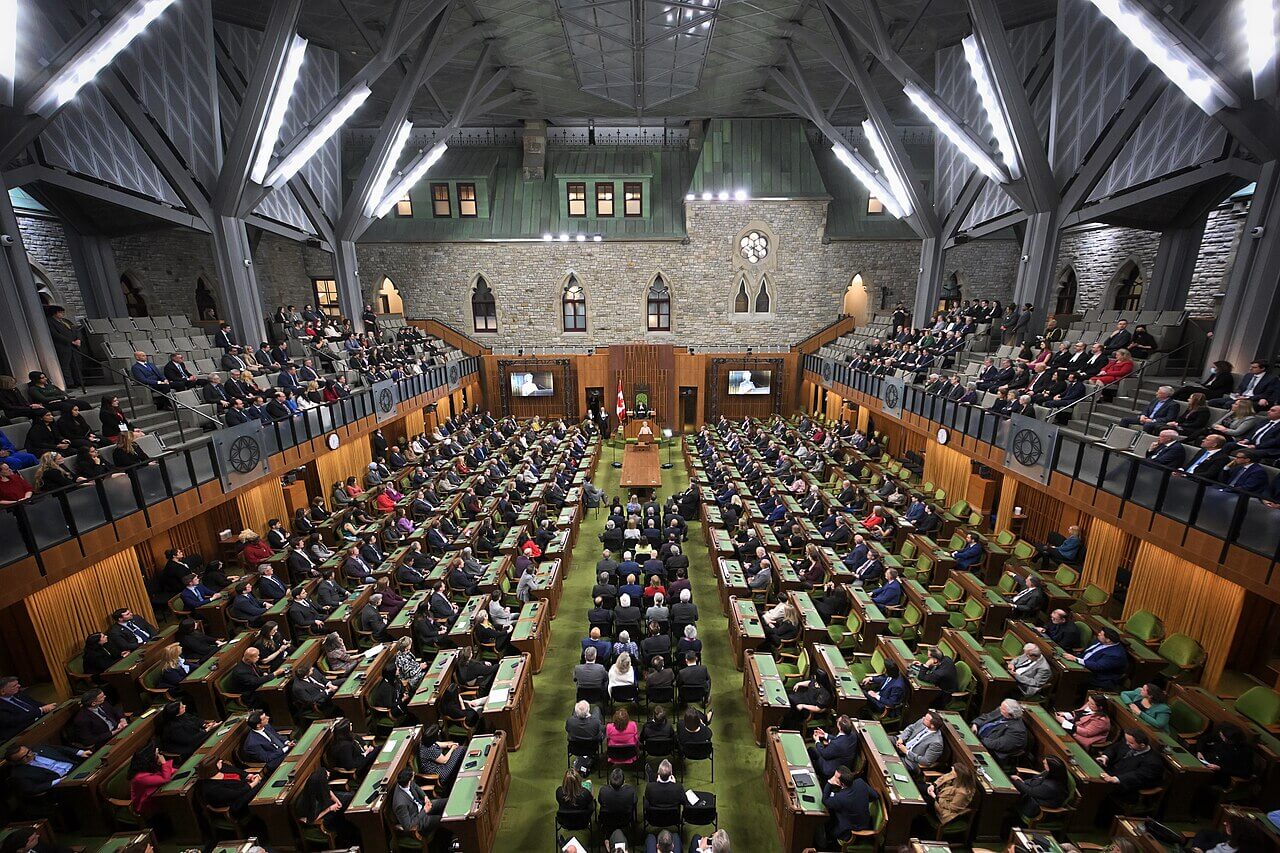
Photo courtesy of <a href=”https://commons.wikimedia.org/wiki/File:Ursula_von_der_Leyen_visits_Canada_-_P060471-362871.jpg”>© European Union, 2026</a>, <a href=”https://creativecommons.org/licenses/by/4.0″>CC BY 4.0</a>, via Wikimedia Commons